Home

Honeybee Trapout For a Friend

Leave a comment

When it comes to rescuing honeybees I have decided to leave that for the younger keepers and those more willing to work off ladders and willing to suffer the Texas heat. I am willing to go round up a swarm out of a bush or off the ground or, as in this post, a low to the ground trap out opportunities. In this case the only entrance was at the base of a tree and lent itself to a relatively straight forward trapout effort for me.

So, what is a trapout? I had to laugh at my research for this blog post. There was one site that referred to the process as “glacially” slow…..isn’t that the truth. Three to four weeks is a likely time frame. It requires that all entrances to the colony inside whatever it is are reduced to one single opening. I had one several years ago before I narrowed down my acceptance of such jobs, that went on almost 6 weeks and about $40.00 of caulking to seal the roof line access gaps. Yes, I got them out, but no, I did not capture them. Success too many times is minimal but here in the south, chances for success are much better.

How did I do on this effort? I was very pleased with my one-way escape plan. The cone was as perfect as I have ever built. The tree lent iself to the process with it’s low opening and broad trunk base making the escape truly one way. Using the 1/8 inch hardware cloth is sized so bees cannot squeeze back in and the cone long enough and tight enough at the escape point to prevent a return to the colony in the tree. Returning bees are guided primarily by scent and prior orientation flights for the tree’s access hole. The cone screen material actual makes it impossible for the retuning bees to see the 3/8 inch escape opening.

First things first. I brought out a 10 frame deep box with 4 or 5 frames of drawn comb and the rest were undrawn frames with foundation. In a classic trapout I could have opted to add a frame of brood and nurse bees along with a queen but chose not to….It was a long shot, but I hoped I could get returning foragers into my box, adding nectar and pollen while awaiting the queen and attendants to be starved into leaving and taking up residence in my box.

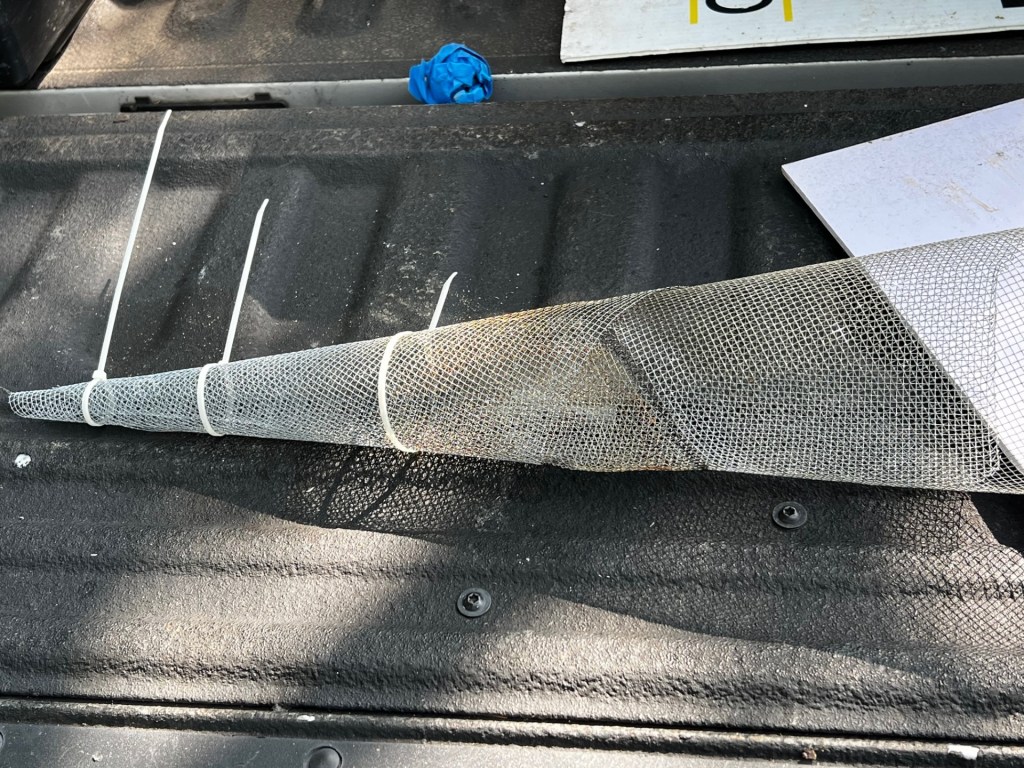
I measured the tree base and cut a screen big enough to more than cover the hole with plenty of lagniappe to adequately force the bees out through the cone.
My damn near perfect cone – pat myself on the back!!!!!!
Box set near the base of the tree and prior to adding the escape.
All set and after an hour or two observing and 2 beers of some sort, I was pleased to see that bees could only escape through the cone and not find a way back into the tree.

Now, several week later I went out to observe. Clayton, the property owner, informed me that there has been no activity escaping through the cone for quite some time. I drove out to see what was going on. There were maybe a few hundred bees in the box, some the drawn comb was wet with nectar indicating that the escapees had been working but not any evidence that they had tried to set up housekeeping. Then I noticed some small hive beetle larvae slurping up nectar on some of the frames but not to the point of sliming and ruining the comb……Now scramble time for me. It became obvious that the colony did starve out and likely absconded. The few bees remaining were either stragglers or robbers. I did have a very nice swarm captured several weeks earlier and they seemed to be growing fast. I placed them into a 5 frame box and prepped them to travel and take up residence in the box at Clayton’s place. I should actually say, at Clayton and Aurora’s place.

The swarm capture from several weeks prior…..healthy size swarm.
Feeder in place and entrance reduced to help the colony manage potential robbers.

I added the previously captured swarm and purged the few wet frames and those with small hive beetle larvae with good frames. Now time to seal the hole in the tree, otherwise the scent will be a magnet to any bees looking for a home. Success in some ways, maybe not so much for the colony that absconded, summer is not a good time for bees to swarm……summer in this part of the world may be short on the resources they need. I needed a home for the swarm I caught so that is a win here.

TTFN

Bishop
Blueberry Pollinators

Leave a comment

“Surprise, surprise, surprise!”…… to quote Gomer Pyle USMC, and of course “Shazam!”. Yes honeybees are used but, they may not be the perfect choice! I am going to include a link to an article from North Carolina State University that will tell a very detailed tale of blueberry pollination in that state’s commercial blueberry fields and mirrors some of my lay observations on a local blueberry field where I kept some bees for a few years. The location was just a bit too far from home to effectively care for the hives. My observations got me thinking…..I had three strong hives on the property and when the flowers were blooming I saw more bumble bees visiting the flowers than honey bees……the honey bees seemed to be more active on the adjacent blackberry vines…..There had to be a reason of some sort!

“Numerous native bees (including bumble bees and solitary bees) are indigenous pollinators of blueberry plants in North America. In addition, honey bees are used extensively by growers to augment populations of native pollinators. Bees are attracted to the flowers by odors and sweet nectar that is produced by glands near the base of the stigma. Both pollen and nectar serve as food for the bees and their offspring. As insects visit blueberry flowers, pollen adheres to their bodies and is carried with them as they move from flower to flower. When bees probe for nectar inside a flower, they brush against the stigma and unwittingly leave behind some of the pollen they are carrying. Some species of bees vibrate each flower with their flight muscles as they collect pollen. This buzzing activity (known as sonication) shakes pollen from the anthers so it is easy to collect, and also tends to increase pollination” will occur.

Read more at: https://entomology.ces.ncsu.edu/small-fruit-insect-biology-management/blueberry-pollinators/

https://entomology.ces.ncsu.edu/small-fruit-insect-biology-management/blueberry-pollinators/#:~:text=Important%20blueberry%20pollinators,augment%20populations%20of%20native%20pollinators.

I wrote this several months ago and found it in my saved for future editing so I resurrected it just in time for Easter. I hope you like it.

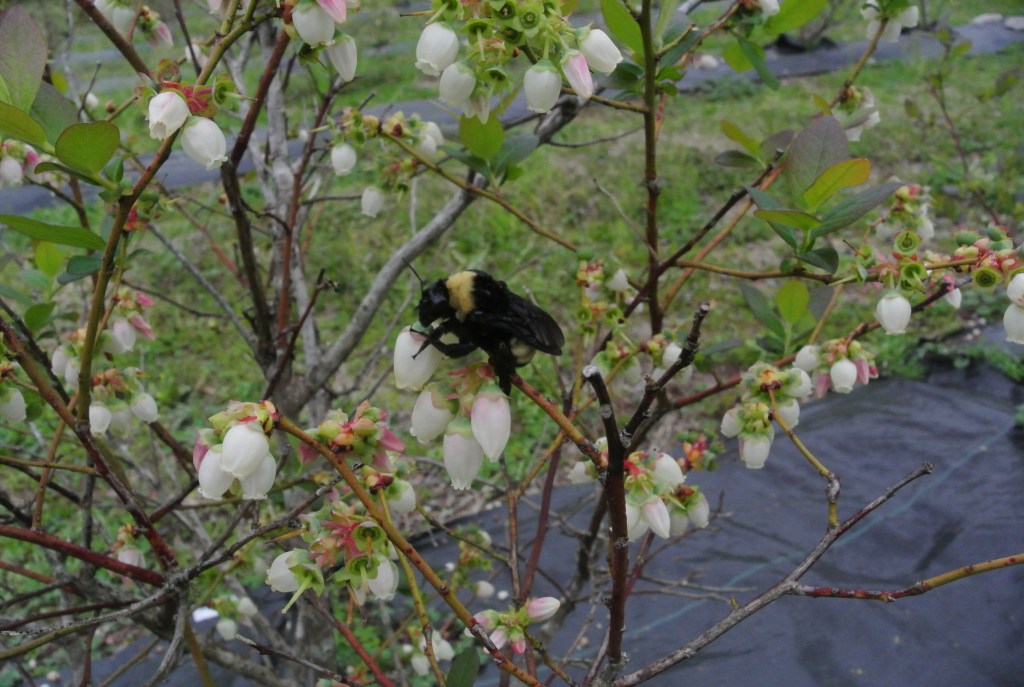
Pay attention to the flower size compared to pollinator size……this is either a bumble bee or ? I don’t believe our area is native to the Southeastern Blueberry Bee! These big guys use a form of pollination called “buzz pollination”. Electric toothbrushes work well too……LOL

One of my honeybees I suspect from one of my hives nearby. Note the size difference to the other pollinator working the blueberries above.

Yessssss Buzz pollination is a thing and I have had success using it on heirloom tomatoes that do not set fruit when this Houston weather gets warm and sticky…..like way too often. I have used an electric toothbrush, sadly my wife won’t let me use hers so mine is the vibrating device that does the trick. I will be doing some of that today as my Brandywine Tomato is beginning to set display flowers. Check out one of my long, long time ago posts broaching the subject with an included video of the technique. It is very effective.

Enjoy looking back into my past.
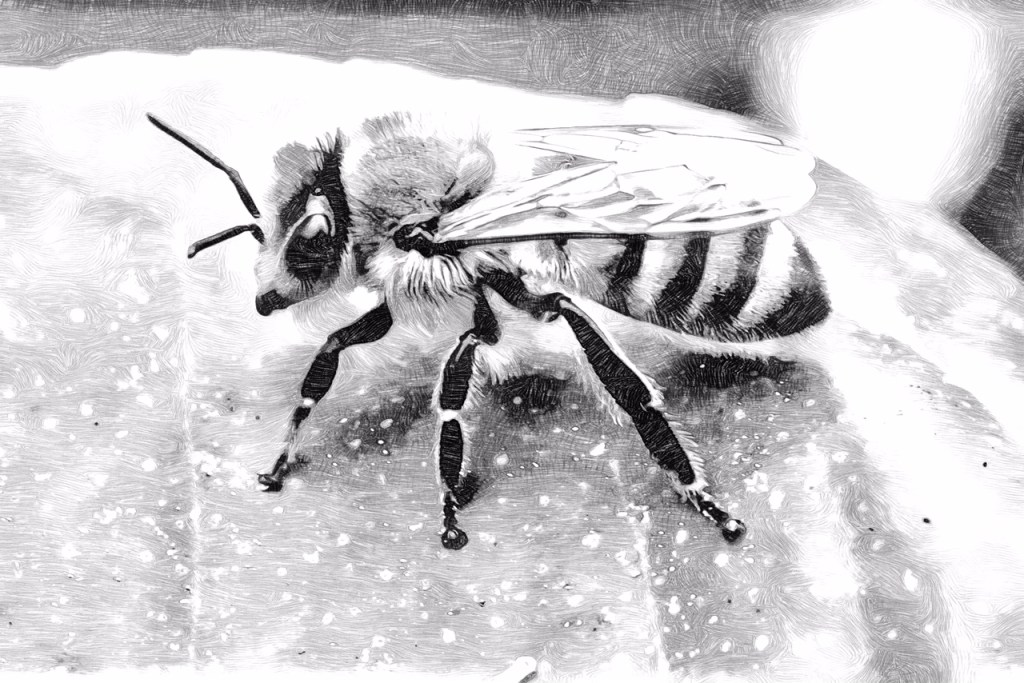
One of my favorite bee photos converted to Black and White with an artistic treatment added.

TTFN

Bishop

Pollinators Are So Much More Than just Honeybees!

1 Comment

I have making an attempt to do some self talk and improve my numerous past resolutions to more regularly immerse my self in blogging, whether it be for the Backyard Farm one here or my “Bishop’s Beer Blog”… https://bishopsbeerblog. I actually love the catharsis that envelopes me when I put thoughts about my favorite things onto “paper” ….. I guess you can call words spread across this page as “onto paper”…. I need to thank Jennifer Moore, https://wayward-bee.com/2022/01/13/how-to-grow-bees/ for her article that gave me a push I needed to write this one……It has been in the planning stages for nearly 3 years or more. Problem with my mental filing system is that it has aged and probably not very well …… LOL. Now, be kind if you visit her site…..She is a Brit and my Australian and Canadian buddies have labeled me an “Anglophile” and it is not as a compliment. When I was being an active follower of her site I learned an awful lot of useful stuff and have a brilliant poster she put together on my dining room wall, Sustainable Beekeeping; https://wayward-bee.com/sustainable-beekeeping-poster/ Please give her a look…..Another big plus for Jennifer is that she is a lover of sourdough bread, as am I. Poke around on my previous blog posts here and you may run across a recipe for using spent grains from my brewing to make bread……most of the grains now go to feed the chickens at one of my nearby apiaries ……and yes I have digressed…..so where was I?

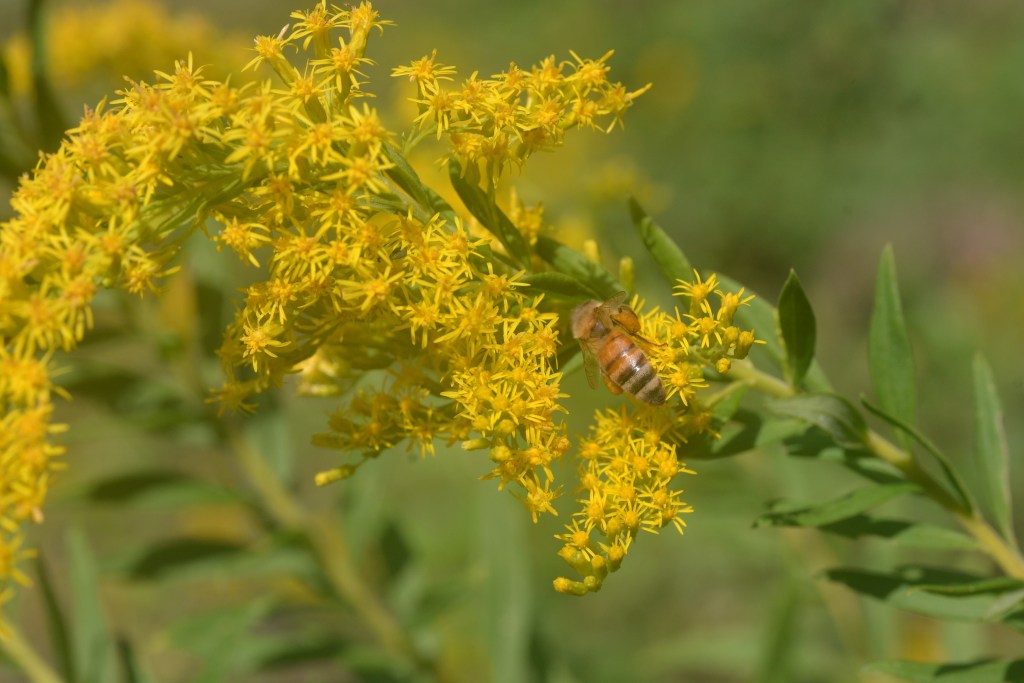
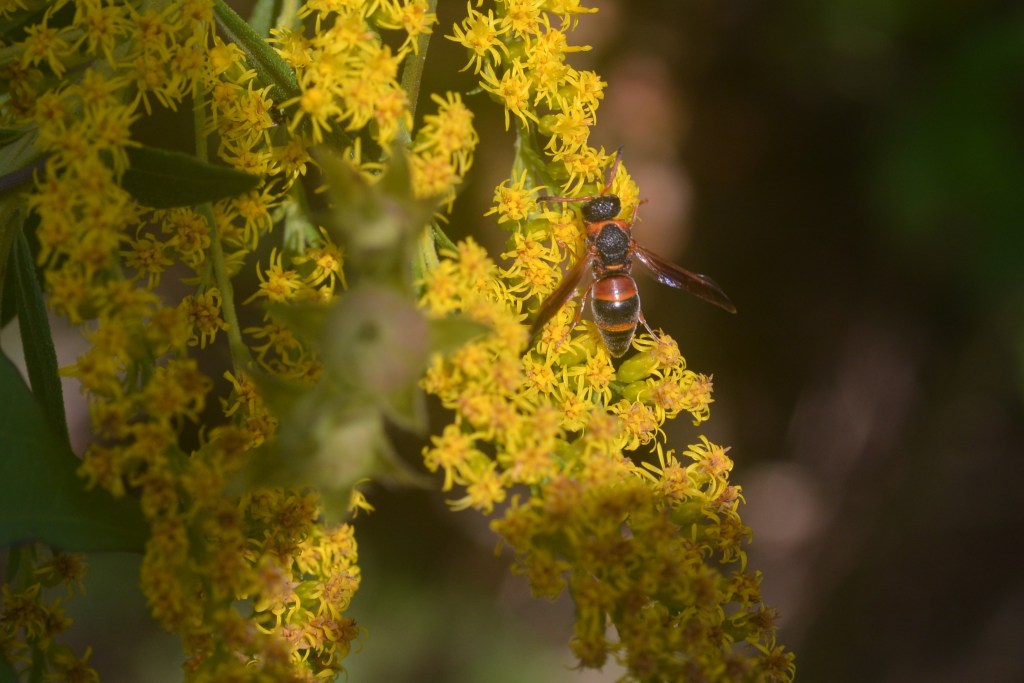
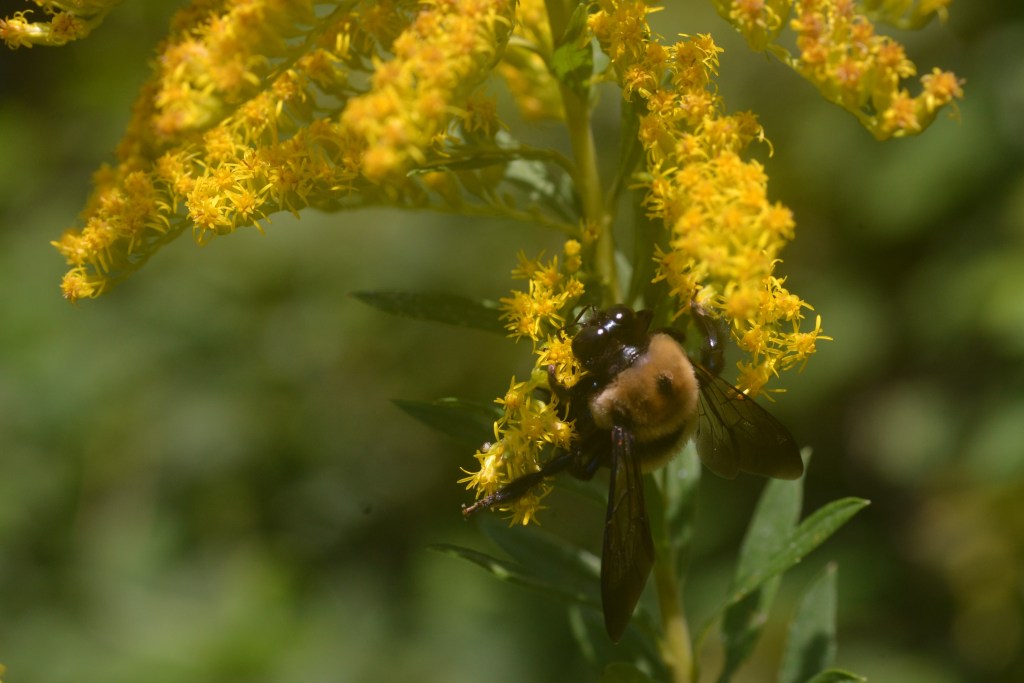
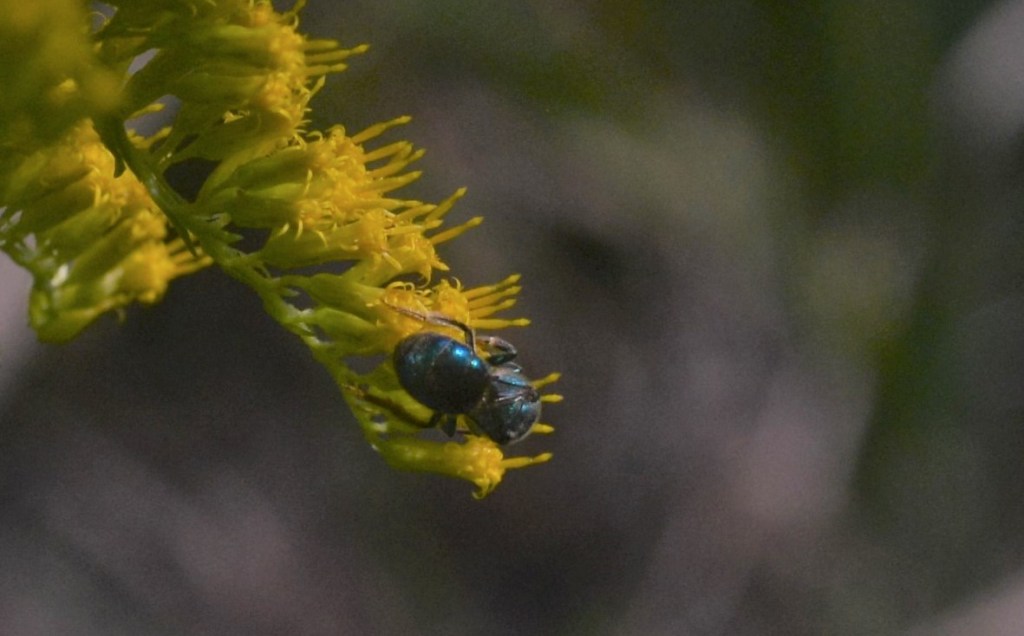
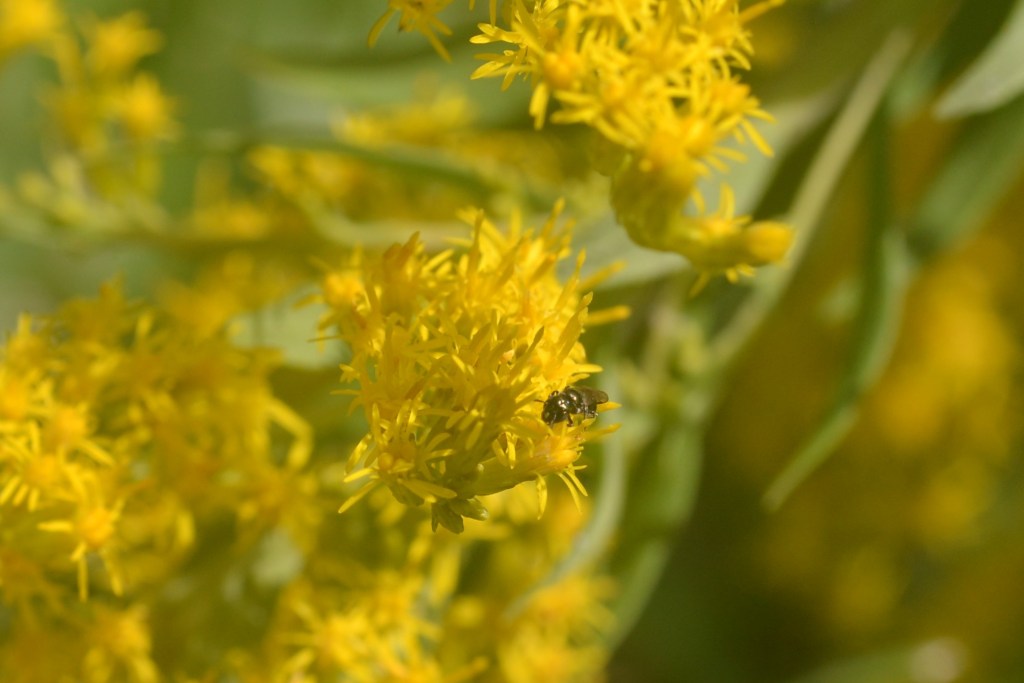
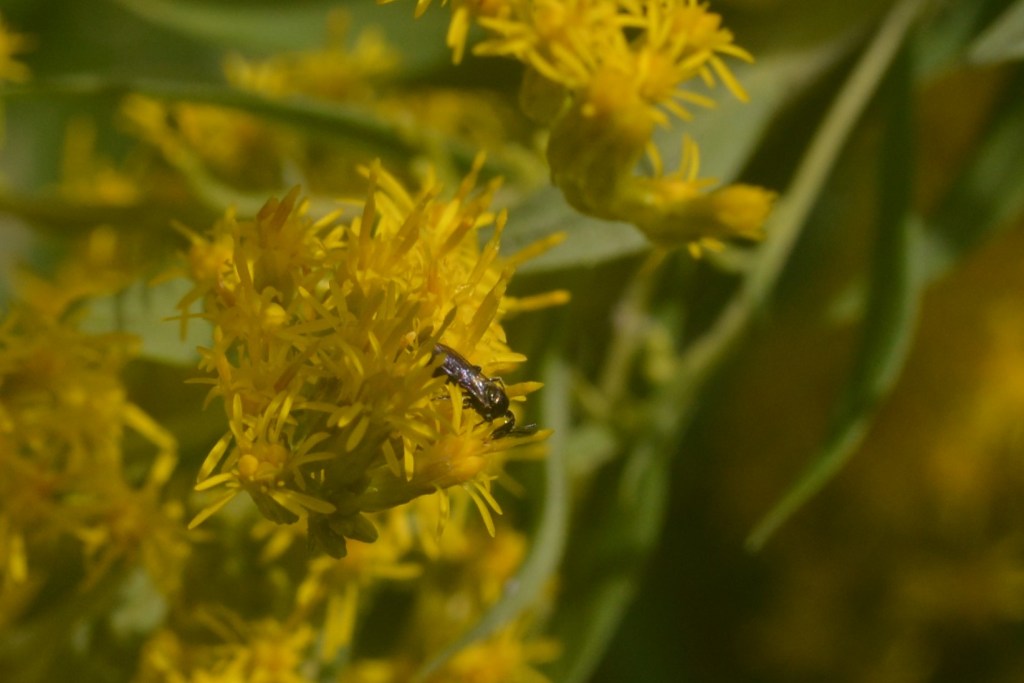
A few years back during the fall Goldenrod flow I grabbed my camera and macro lens to visit the bees foraging on the blossoms. Here in my area of east Texas the Goldenrod is a major component of what bees can put away for the winter…..the weather here is rather mild here but that can create problems for the bees too. Gives them false hope and they can start to brood up and then a freeze hits and they go through their stores rather quickly. This was probably Fall of 2019 or 18 when I first took a look and I was surprised at the variety of winged critters swarm on the Goldenrod! Something else that I will add about Goldenrod…..the heads of the stalks are, yes, brightly golden, but on closer examination the blossom heads are a collection of incredible dainty and small individual flowers. The photos below will include honeybees and you can use them as a reference against the blossom size. I was amazed once I got down onto my belly and closely examined and photographed the drooping blossoms. With that perspective I saw winged critters almost too small to see as they flitted around….

Next group will include the teeny and tiniest that I was able to observe. All of the photos in this blog were shot in October of 2021 with a Sigma 90mm Macro lens……and yes I am still practicing. Before I will go on with some more photos I will reference Jennifer again. Her “how to grow bees” post really addresses what we need to create a winged critter friendly environment. When I have discussions with folks about my beekeeping I get lots of comments about protecting honeybees. This allows my to bring the discussion around to the myriad of pollinators that very few people even realize exist. I have a little shelter in my backyard that houses Mason Bees through out the year……unknown to many is that they may actually be a better pollinator than honeybees – they are also known as Orchard bees. You will notice wasps and hornets on blossoms….their larvae need protein to develop of which pollen is the key ingredient. And others that I have zero knowledge of what they need and how they utilize it. 2023 I may make a concerted effort to polish my macro lens skills and attempt to catalog the many winged critters on the Goldenrod.

Hope this gives you a better understanding and knowledge about pollinators and not just honeybees.

TTFN

Bishop

Post Freeze Update

2 Comments

December 22-24 my garden experienced a danged good freeze…..well, the freeze is not really good for the garden, so a better term would be…….an extended period of freezing weather of hard freezing temperatures. What is considered a hard freeze in this area, Kingwood, TX just north of Houston? A hard freeze warning is issued when temperatures drop below 28° for 2 hours or longer. Well, we had about 36 hours and it required some effort to help our cold intolerant plants from dying……….some didn’t make it!!!!!

My wife had a good number of ornamental plants that we covered in an attempt to minimize the damage with some success. My biggest worry was my Meyer Lemon tree that was nearly destroyed in the 2021 major deep freeze……yes Texas made national news on that one. I managed to get some recovery of the tree after the 2021 freeze and was optimistic that I would finally get some fruit as it was beginning to blossom…….I was able to protect, marginally, about 1/3 of the tree. More on that later.

I had been attempting to get some succession plantings of beets, carrots and sugar snap peas started. We had run out of coverings for my veggies so it was plan L time. Plan L stands for leaves, lots of leaves and deeply piled leaves. I did have some success. One failure were the sugar snap peas that had climbed over 20 inches up the trellised string ladders. I will tell you that some of the peas had not yet started climbing and and they were lucky enough to be buried under a thick cover of leaves.

Carrots upon uncovering looked very, very healthy.
After uncovering the beets, lo and behold, one of two snap pea vines were discovered. I hope to get them trained up the trellis this week. I also added 15-20 snap pea seeds that had been soaked over night.
Soaked for 24 hours in order to imbibe and be ready for the garden. A tip, if the seeds float in the water rather than sink to the bottom of the cup they will not be viable.
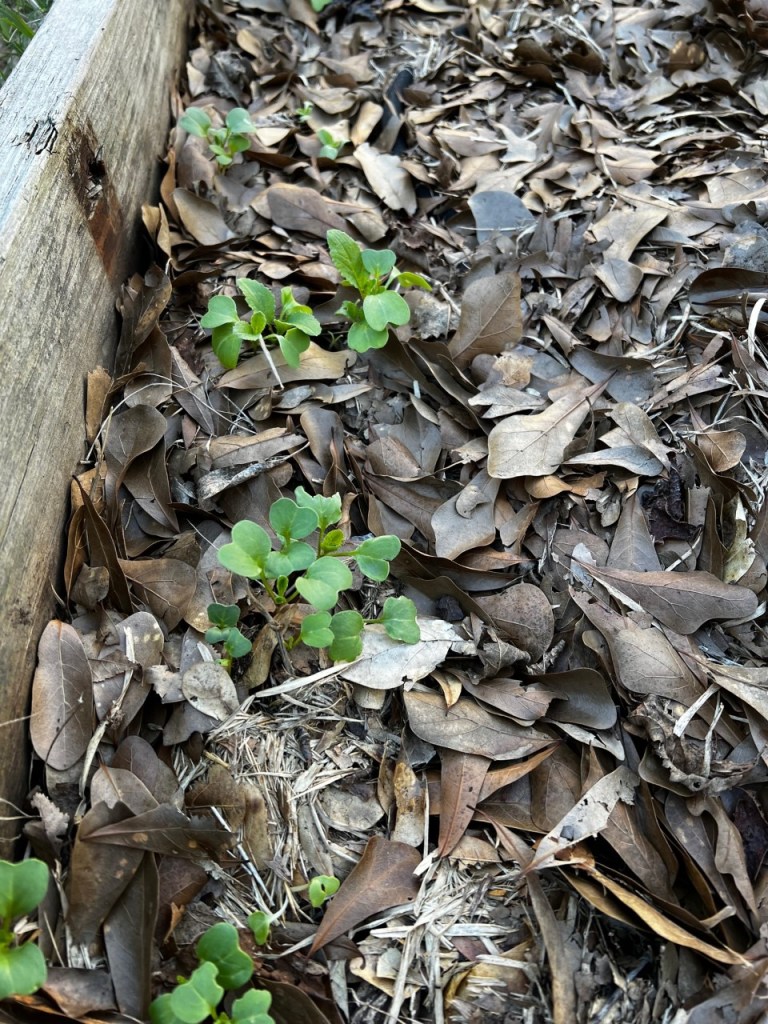
Next round of carrots emerging and they will extend my harvest a bit longer.
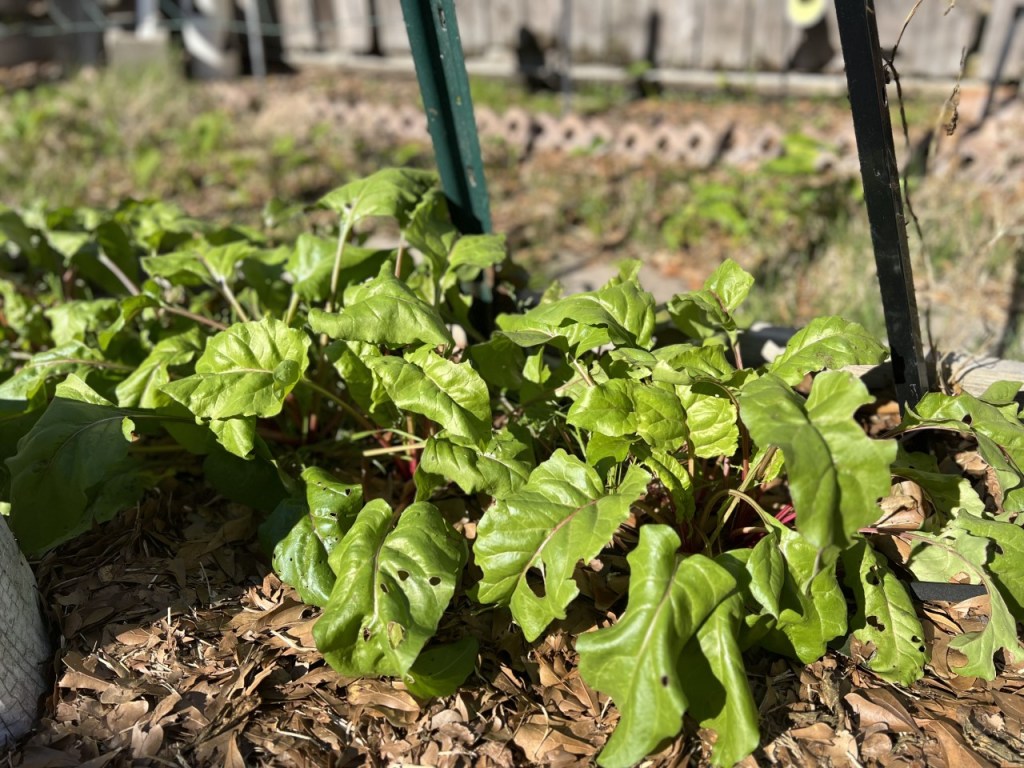
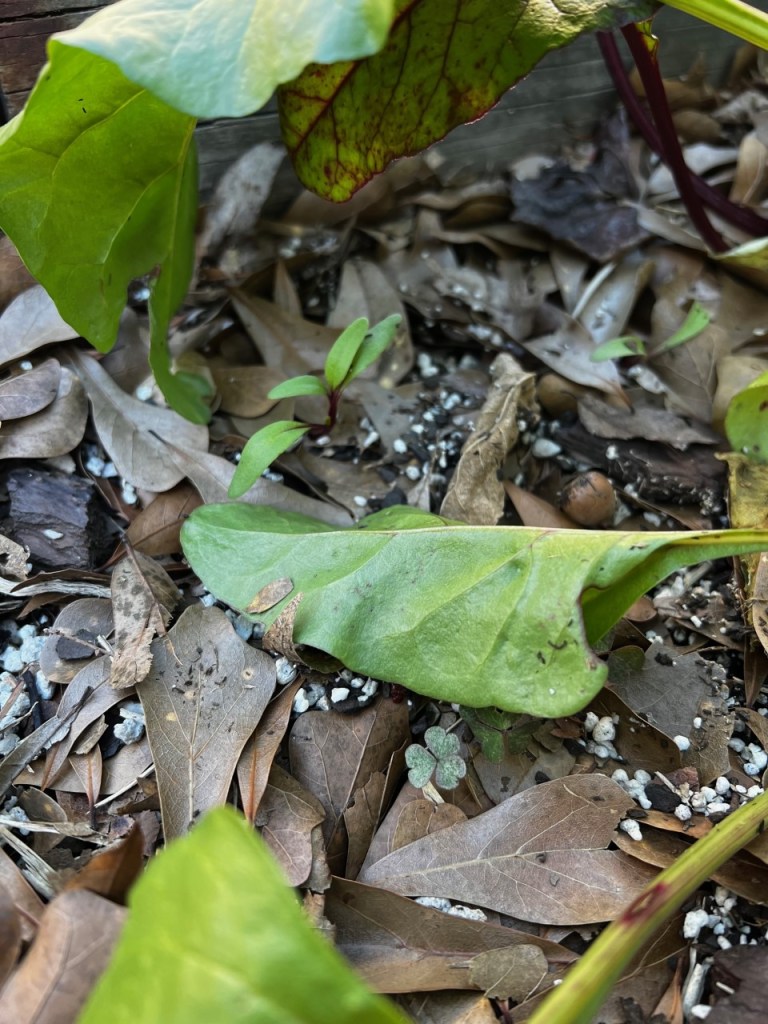
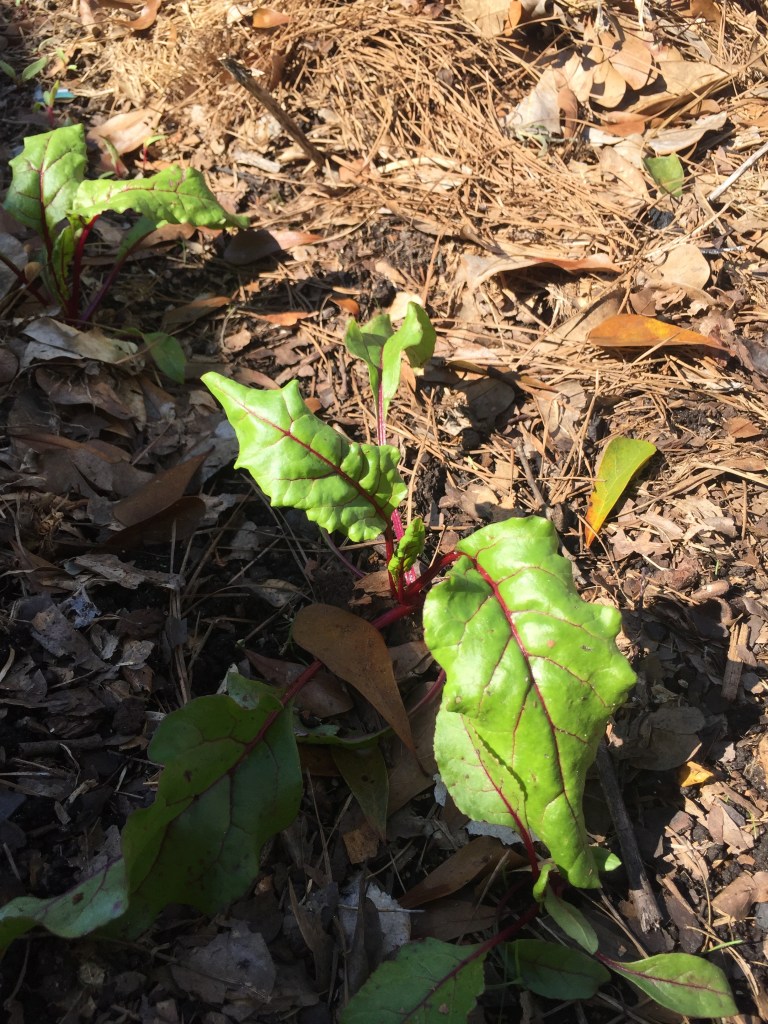
Another discovery…..young beet sprout that lay dormant until I removed the insulating cover of the leaves….they should also help extend the beet harvest.
Sadly I will just have a handful of surviving blossoms this year on the Meyer Lemon tree. Although I did not shoot a photo of it, but some of the damaged and dormant branches are beginning to leaf out…..gives me reason for optimism.
Oh…..some radishes…..don’t even know why I toss out the radish seeds, they are rarely eaten, except by garden pests but, they do stroke my ego a little because they will sprout quickly and visitors will compliment me on my green thumb…….as my chest puffs out. If they only knew…….

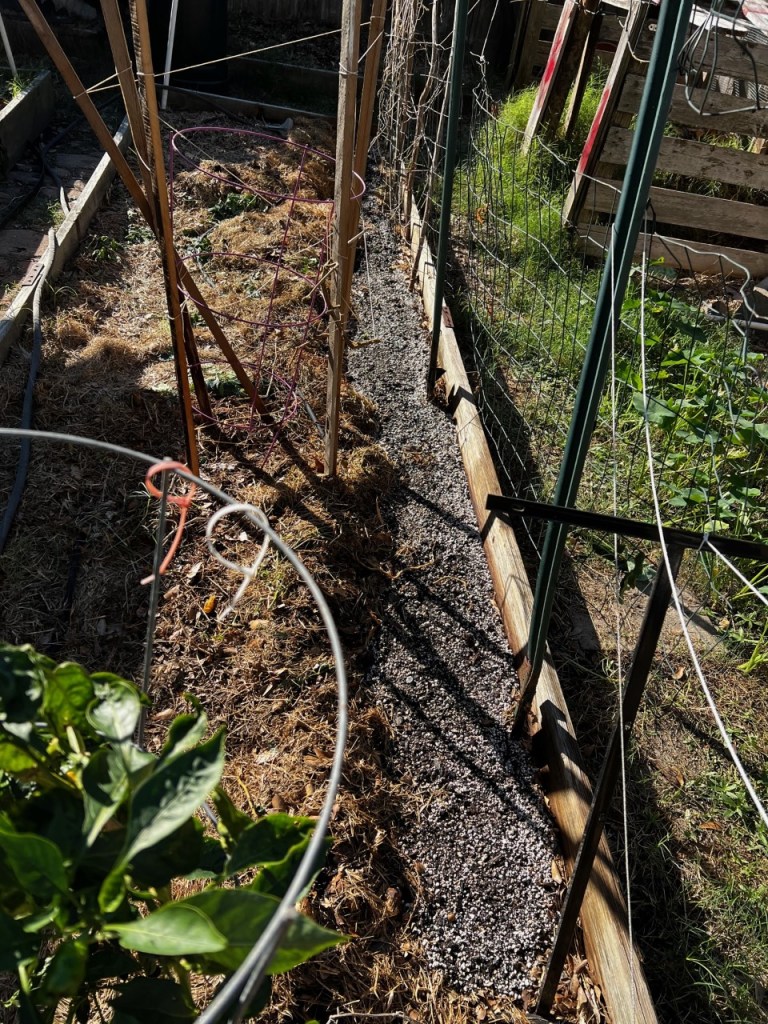
Looking forward I will add in some more beets, most likely another round of carrots, trellis up the peas, no more radishes and begin composting an enormous supply of fallen leaves. Just an FYI, I no longer till my garden plots. For the last 4 or 5 years I have just piled on leaves and grass clipping to suppress the weeds and add to organic material to the soil. In my humble opinion…..the fertility of my beds has markedly improved and the weeds struggle, they don’t disappear but the become more manageable.

In March tomatoes and peppers will go in. Maybe a week or too before that a couple of mounds of Irish potatoes will be added. Then a couple of teepees of beans of several sorts. I will grow Blue Lake and Kentucky Wonder pole beans…..last year’s crimson variety grew huge……and only produce a few handfuls…..going back to the trusted varieties.

TTFN

Bishop

Second Start on my Fall Plantings

1 Comment

About 5 weeks ago I began to ready my garden for fall and put some cool weather veggies in. I planted seeds for beets and Sugar Snap peas. We had been in a long period of drought here in the Houston area and the prospects for rain were slim. My poor luck was made worse by an extended period of time spent out of town to help out with grandkids thus, the seeds failed to germinate. I should have drafted some help to water in my absence but did not. So, today I added carrot seeds and beet seeds. I know that beet seeds are not the typical looking seed that you would recognize.

Beet and chard seeds are multigerm seeds. (Quick botany lesson: The germ is the reproductive part of a seed — the embryo — that grows into a new plant.)

Multigerm seeds occur when flowers grow in clusters, fused together by the petals (such as the flowers on a beet plant), which then produce multigerm seed balls.

When the seed balls germinate, they may have two to five seedlings sprout all at once. https://www.gardenbetty.com/why-do-multiple-seedlings-sprout-from-a-beet-seed/

I intend to do my beets in a long row and do succession planting every few weeks. This phase 1a ….. as Phase 1 failed.
In this area I am doing carrots that I have broadcast in 4 wide bands and will thin once they begin to sprout. Two varieties, Red Rocket and Danvers. They both seem to do well in our dense soil here in the Houston area.

I have challenged myself to do a better job keeping the seeds wetted this go around. Our weather is chilly for the next few days or two but next week we are back up into mid 80’s and mid 60’s at night. Perfect temperatures for the seeds and “multigerm seeds” to germinate. Insert smiley face here…..

Sugar Snap Peas are soaking tonight and will go into the ground tomorrow. I always let them soak over night and imbibe enough water to fill out the wrinkles…….Hmmmm maybe I need to imbibe a little more and see if my wrinkles will fill out! I wonder if beer would have the same affect on me. Maybe a winter time experiment.

Shifting gears. I have two large 4X4X4 compost bins and I am pretty consistent hauling kitchen scraps, egg shells and coffee grounds out to the bins. All of my grass clippings and leaves wind up either in the bins or as mulch helping to smother the weeds. (a never ending challenge). I am a bit proud of the fact that I have not sent any grass clippings nor any of my Fall leaves to the landfill in over 10 years. About 5 years ago I gave up on turning and tilling my beds and they seem to be as productive as ever. I have hired several thousand earth worms to till for me and because of their anatomy I have not paid one back injury claim, even though I employ thousands. (tongue in cheek)

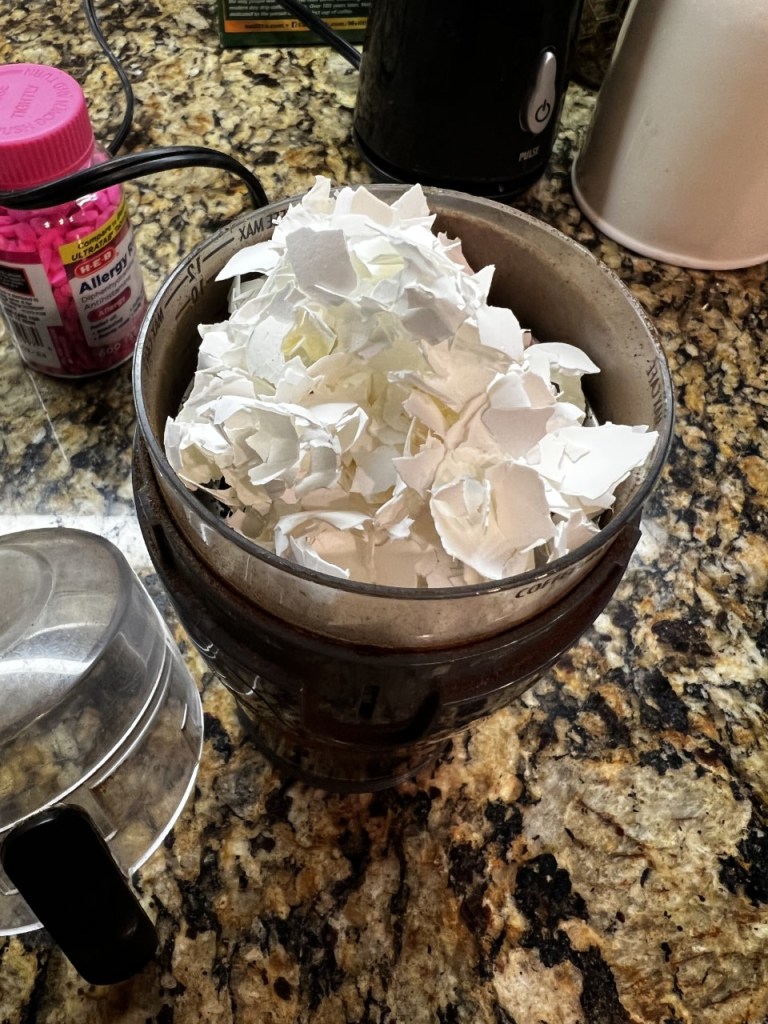
I know that my egg shells take forever to break down so I have started drying them and pulverizing them in my coffee grinder. I do grind coffee every couple of days and I decided to tolerate and residual calcium dust in my grinder as a bit of dietary calcium. so far no ill effects …….. fingers crossed. The article I read suggested using a mixer, coffee grinder or a mortar and pestle to reduce them. My mixer wouldn’t be very efficient, mortar and pestle sounds like work and my arthritic hands would protest, so…….the coffee grinder is my choice.

Dried and ready grind up into some dust.
I probably could have spun these in the grinder a little longer. I am bagging them now and in the spring I will add them into the planting holes for tomatoes, reduces blossom end rot and for my peppers.

Plants like tomatoes, peppers and eggplants in particular will benefit from shell fertilizer. The extra calcium will help prevent blossom-end rot. Broccoli, cauliflower, Swiss chard, spinach and amaranth are also calcium-packed and could use extra from eggshells. So there you go…..waste not want not. Just in case you were curious about he origin……and I was….I assumed it was from Benjamin Franklin but was proved wrong

Waste not, want not – Grey Bears

https://greybears.org › waste-not-want-not

“We’ve all heard the proverb, “Waste not, want not.” This old saw has its origins from 1576 in, The Paradise of Dainty Devices by Richard Edwardes, a distinguished lyricist and playwright who was rumored to be an illegitimate son of Henry VIII. On page 88 the proverb was written as: “For want is nexte to waste, and shame doeth synne ensue.”

In 1721 the saying was recorded in an easier to understand version: “Willful waste makes woeful want.” Then, on August 10, 1772 in a letter to Alexander Clark, John Wesley wrote the saying in the more familiar: “He will waste nothing; but he must want nothing.”

All of the various forms of this proverb get at the idea of how we can always have just what we need. The less we waste (or acquire), the more resources we save and the less we’ll want for anything later. Waste not, want not reduces the risk of poverty and need. Put another way, many of us are saving money for something we’ll need or can afford in the future (savings). We will opt to not have what we may want/desire now in order to preserve what we need/want in the future.”

Maybe it will come up one day in trivial pursuit or on Jeopardy and you will be well armed.

TTFN

Bishop

Backyard Farm Resurrection

4 Comments

June of 2021 was my last update, don’t get the wrong idea…….I haven’t given up on the garden……but nearly given up on my blogging. Oh, I have good intentions, taken photos, jotted down notes in my brain……an unwise and not secure place to store thoughts…LOL. A friend began shaming be about the hiatus and I agreed to be more diligent!

One of the aspects of gardening that bothers me, but I also realize that thinning when planting by seed is a necessary evil…..the taking of a life….pulling out a crowded seedling and seeing it suffer, wilt but yet, create the circle of life becoming organic material for the soil. oh well, necessary for those that grow to harvesting size.

Thinning activities are happening with the carrots and the beets. Need to be sure to wear my reading glasses because, too often, the emerging seedlings are almost twins!

Some emerging beets previously thinned.
Carrots poking up through the leaf mulch. So delicate at this stage so I really need the reading glasses for my 70 year old eyes.
Some beets with a head start. My first plantings were from a packet dated for 2017 so germination wasn’t too good! latest beet seeds are 2021 season packets, both red and golden.

Sugar snap peas aren’t cooperating at all so I may have to try again in the spring. I have added some bases off of celery stalks and, lo and behold…..they are taking hold. Hopefully they take off and enjoy the cool Houston fall and winter.

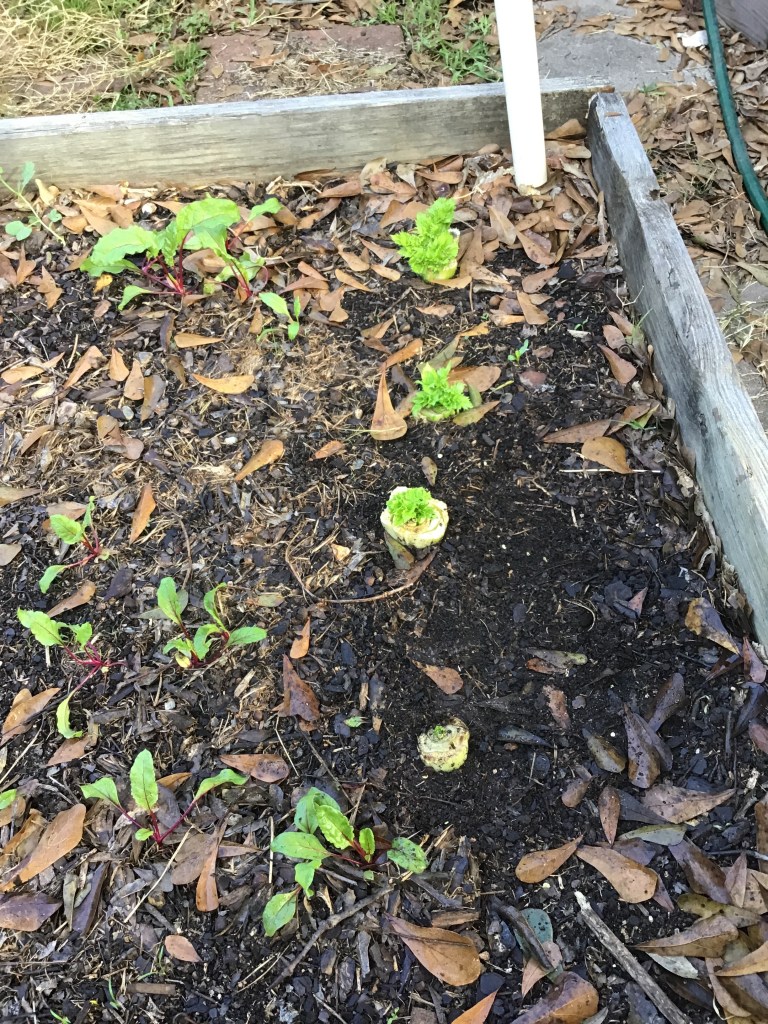
It should be pretty obvious which one went in first and which one was last. I may continue and eventually make an edible border in the garden! They also share space with some beets….they seem to get along pretty well.

Bees seem happy and I will do my best to help them through the winter….I will share more about them soon…..really I will!

TTFN

Bishop

Blueberry Syrup…. Yummy

1 Comment

My wife was needing to make some room in the freezer and a bag of blueberries I picked last summer was blocking her efforts. Rather than toss them out I decided to make some blueberry syrup. I love it on pancakes and Blue Bell vanilla ice cream. After defrosting I found that, magically, I had the perfect amount for my recipe.

It took a little longer than I anticipated and I did deviate from the recipe as described below. The results are fine!!!

Step 2. Preparing the base syrup sugar water with the lemon zest. I used Meyer Lemons from my garden….maybe not perfect but I think it worked out well.
Hard to see but I had no luck after 25 minutes with getting the syrup up to 225 degrees F.
Added the prepared blueberry juice and went to plan B. Pulled out my Cajun burner and cranked it up…..hit 225 F very quickly.
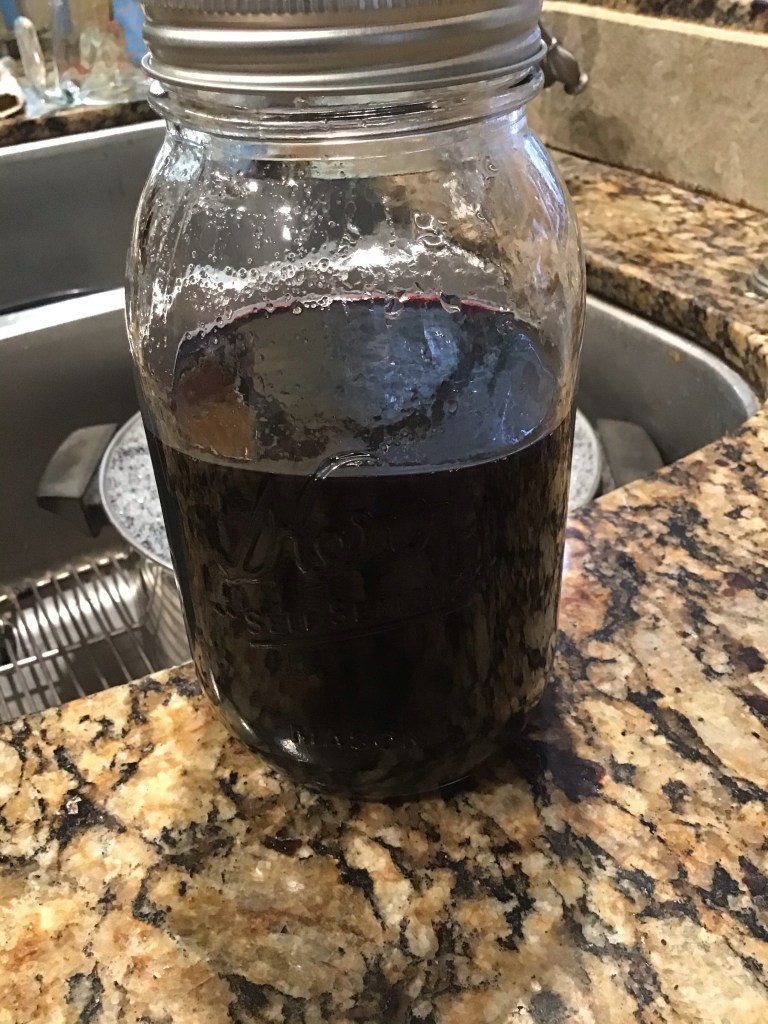
Final result is a little over two cups of very sweet and very tasty Blueberry syrup. Sunday is ice cream day at the Decker house…..guess what I am having?

Blueberry Syrup

  • 1 1/2 pounds blueberries (5 cups)
  • 4 cups water
  • 2 cups sugar
  • Six 1-inch strips of lemon zest removed with a vegetable peeler
  • 3 tablespoons fresh lemon juice

Directions

  • Step 1 In a pot, combine the blueberries with 1 cup of the water. Crush the berries with a potato masher and bring to a simmer. Simmer over low heat for 15 minutes. Strain the juice into a heatproof measuring cup, pressing hard on the solids. Discard the solids.
  • Step 2 Rinse out the pot. Add the sugar, lemon zest and the remaining 3 cups of water and bring to a boil, stirring to dissolve the sugar. Boil the syrup over moderate heat until it registers 225° on a candy thermometer, about 20 minutes. Add the blueberry juice and lemon juice and boil over high heat for 1 minute. Let the syrup cool, then discard the lemon zest. Pour the syrup into just-cleaned bottles. Seal and refrigerate for up to 6 months.

https://www.foodandwine.com/recipes/perfect-blueberry-syrup

By Grace Parisi

August 2010

I modified step 2 and chose to add the extracted juice and brought both, the sugar water and juice, up to the final temperature. It seemed to work fine.

TTFN

Bishop

Catching Up…..Spring is on the Way

2 Comments

The quiet time of winter is over here in my backyard just north of Houston. I have been eating beets from the garden as well as some carrots. In fact, last night I grilled a spatchcock chicken along with a handful of freshly pulled carrots…….FYI, I should have pulled up a few more carrots!

I love this water color app called Waterlogue…..orange and a couple of yellow carrots freshly pulled.
Obviously not enough carrots. Olive oil, a little sea salt and rosemary. 8-10 minutes over direct heat and about 15 minutes over indirect heat with the foil sealed shut. FYI, this is a good size of carrot to cook through and not be crunchy in the center.

I have both red and gold variety beets growing along with Romaine lettuce, about 50 new Chandler strawberries. The radishes are done and I could probably plant more but I’m the only one that eats them! Sugar snap peas have been planted, along with some turnips and another round of beets.

Bees are doing well and the early spring bodes well if the weather stays wet enough for the early spring nectar flowers. For you folks in Texas here is a very good list, link attached. Late winter does include my Meyer Lemon tree as a good nectar source….. looks like it will bloom very soon. https://aggie-horticulture.tamu.edu/travis/wp-content/uploads/2016/04/EAGF-2017-Central-Texas-Bee-Friendly-plants.pdf

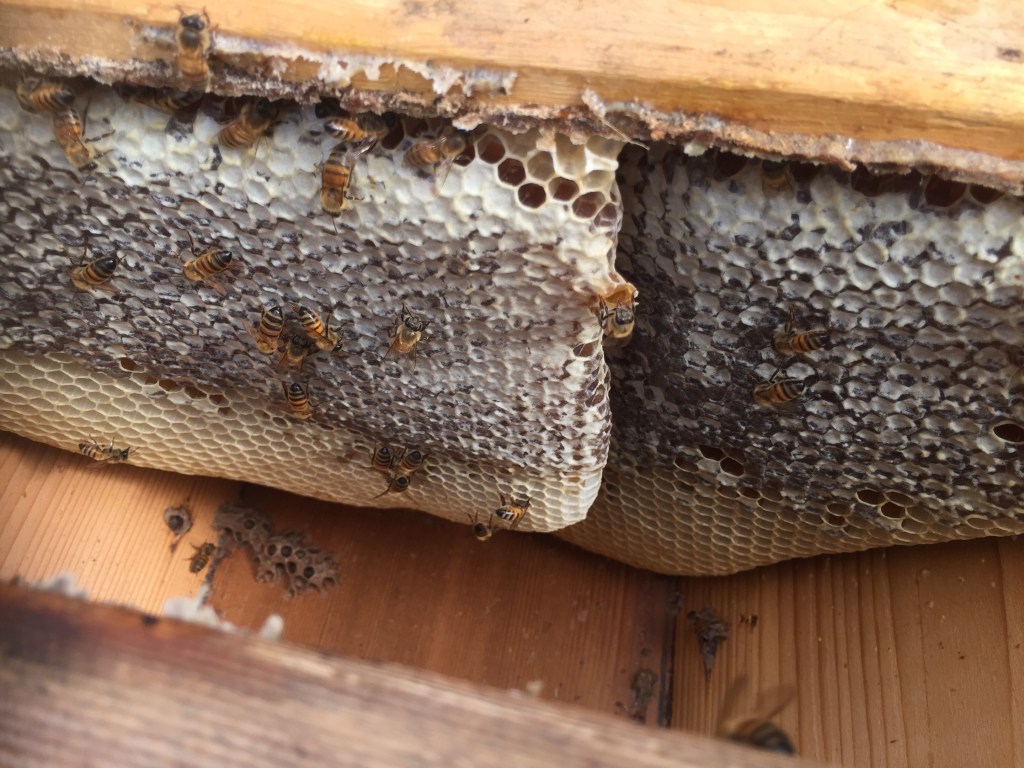
My backyard topbar hive. Bees are storing honey…..this comb is a little wonky so I will pull it and maybe two other misshapen bars to crush and squeeze in a few weeks once I see more nectar flowers blooming.
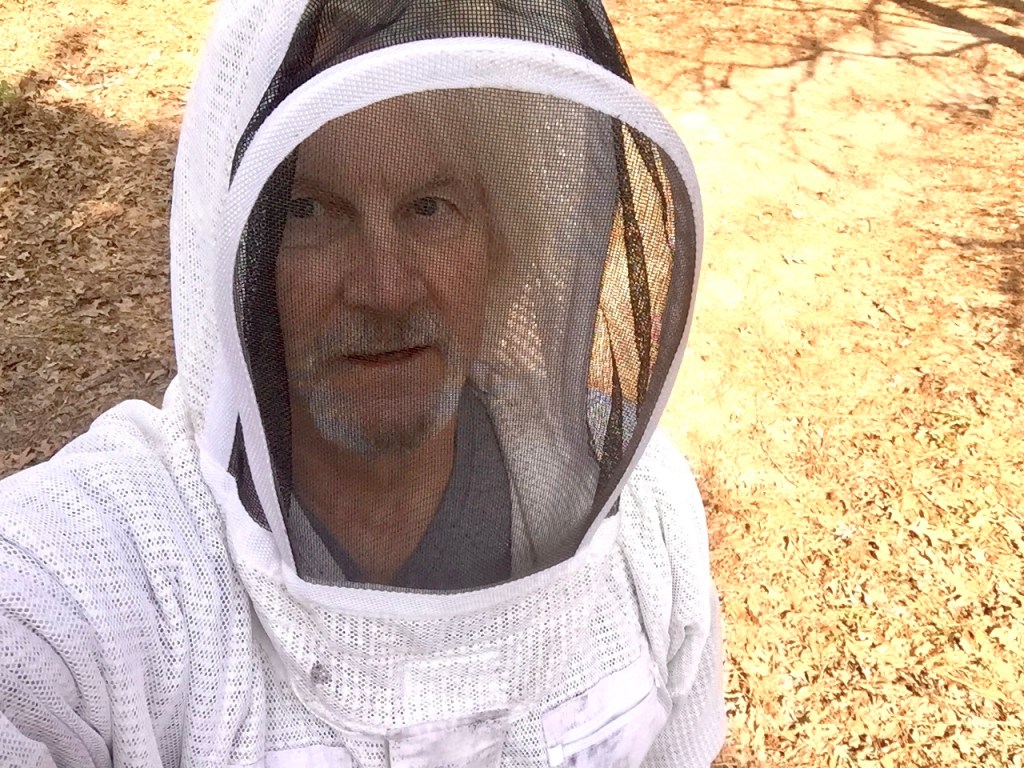
Suited up but not for the backyard bees….my backyard bees are pretty sweet, no gloves or suit needed but I do always wear my veil. I was suited up here because I was cutting weeds and brush around some of my friskier bees!
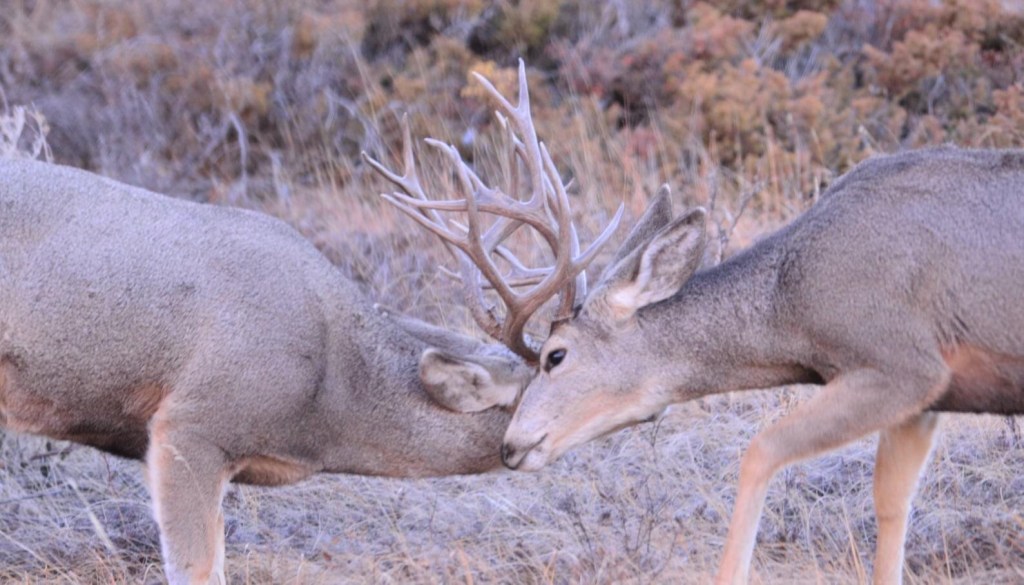
Bonus image from our recent trip up to North Dakota. These two whitetail boys were sparring a bit, not real energetically but grunting a little.

More spring stuff in the works.

TTFN

Bishop
Honey Fermented Garlic Cloves

Leave a comment

I do enjoy fermenting, primarily beer, a bit of wine and mead. I had never heard about fermenting garlic cloves. In fact, it wasn’t even my idea! My wife suggested it and didn’t even ask for my expertise! FYI, I have no expertise in the category of fermenting anything that doesn’t include an ABV % attached to it.

So why? I asked my wife why she decided to embark on this adventure and her immediate response was to receive the benefits of the “Immune-Boosting Effects”. Upon digging a little deeper there are other benefits that should “Reduce Blood Pressure” & Improves Cholesterol Levels, both LDL and total cholesterol.

“Studies have shown that the fermentation process increases the amount of nutrients in garlic and makes them easier to absorb by the body. The highest protein content was available after 60 days of fermentation while the highest fat and carbohydrate content was found after 90 days of fermentation.” From “ WebMD, September 29, 2020”

How to go about it? First prepare the garlic cloves by peeling the skin off by lightly crushing them or buy a big jar of already peeled garlic cloves. She opted for the latter. Next, she took a 1/2 gallon jar of raw honey and filled 3 one pound bottles leaving about 3 pounds, or around 8 cups of honey behind. She then loaded up the jar with a whole lot of garlic…..not a very quantitative measure but accurate. As the garlic settled she added more until the jar was chock full, again, not quantitative but the photo below will illustrate the quantity.

Chock full!

The honey that was used is raw honey…….so what exactly does that mean? Raw honey is best described as honey as it exists in the hive. Raw honey has not been filtered nor heated, has all of the pollen, natural wild yeasts and beneficial enzymes intact. The wild yeasts are the star of the process. As the garlic cloves release water into the honey it becomes wet enough to allow fermentation. Ideally honey is harvested with less than 18% water in order to prevent the yeast activity. In this case we want the % water to rise and allow fermentation.

After the fourth or fifth day of adding cloves up to the chock full point and also flipping the jar over several times daily keeping the cloves covered…..the bubbles were appearing…..fermentation was under way. Now the flipping process includes burping the gasses off……smells very garlicky ….. go figure. Kathy has selected a date about 3 months out for the first taste test, March 12, 2021 when some old guy she knows turns 70……wow! The jar will be stored in a dark cool place once the fermentation slows down. The honey fermented garlic can be safely stored out beyond a year or more according to the researched recipes.

How to use? Just pop a clove to boost immunity response during cold or flu season, this is Kathy’s primary reason for the effort. Cooking, use as a marinade or as a glaze for meats and vegetables. I will attach a link to foraging and fermenting website. Check it out, suggestions include honey fermented cranberries as well as elderberries. I think I will do the cranberries next year prior to Thanksgiving! https://www.growforagecookferment.com/fermented-honey-garlic/

TTFN

Bishop

Armenian Cucumber

Leave a comment

“The Armenian cucumber has a bit of an identity crisis.

Botanically, it’s considered a melon, with seeds and a mushy center that resembles a cantaloupe and a raw aftertaste akin to watermelon rind. Gardening enthusiasts like to compare it to zucchini. But if it’s picked at the proper time, it has the crispiness and flavor profile of a garden fresh conventional cucumber, so that won out in the naming convention.” https://www.mysanantonio.com/food/recipes-cooking/article/Armenian-cucumbers-stand-out-for-size-and-11949986.php

This one is a midsized fruit, 14 inches long by 3 1/2 inches wide.
Ready to be seasoned after coating in olive oil.

I thought that I had allowed the fruit to zoom past right size for picking but apparently that is not true. Up to about 18 inches long they mimic an English cuke in flavor. The really big ones apparently become sweeter and more melon like in flavor. I suspect the larger and sweeter ones may caramelize while grilling adding even more flavors. I will have to report back with results in the near future.

Unfortunately I composted this one before educating myself!

Grilled Armenian cucumber…….I am happy to report that it turned out well. Next time I will season it a little spicier but one thing I really liked is that it retained it’s crunch after grilling. I like grilled zucchini but it zooms past retaining it’s crunch far too fast while grilling…..mush! “While the grill is heating up, slice the cucumber into 1½ to 2-inch chunks and lightly coat both sides with olive oil and sprinkle each side with Spice Rub to taste. Place the chunks on the side of the grill opposite of the coals, and cook for 15 minutes with the lid on the grill closed, flipping once midway through. Move the chunks over to the area directly above the coals. Sear for 2 minutes per side and transfer to a plate and enjoy.”

Turned out very well. It is a keeper and I will do some experimenting to find a spicier rub mix. All in all, we enjoyed the Armenian Cucumber. My “Goo Friend”, chef last night also grilled the zucchini nicely.

TTFN

Bishop
Goo Friend….. there is story there somewhere in my archives. https://bishopsbackyardfarm.com/2016/04/

Older Entries